Basic Life Support (BLS)
Our Basic Life Support (BLS) Programme provides practical training in recognition of cardiac arrest, CPR, rescue breathing, Automated External Defibrillator (AED) awareness and use, airway management, choking response, emergency activation, patient assessment, infection prevention, and resuscitation team response.
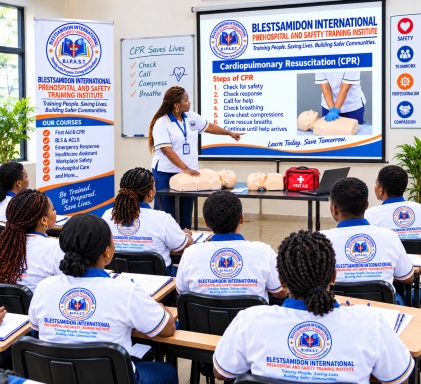
About this course
Our Basic Life Support (BLS) Programme provides practical training in recognition of cardiac arrest, CPR, rescue breathing, Automated External Defibrillator (AED) awareness and use, airway management, choking response, emergency activation, patient assessment, infection prevention, and resuscitation team response.
The programme is designed to equip learners with the knowledge, practical skills, confidence, and teamwork required to respond appropriately to life-threatening emergencies, particularly when a person is unresponsive and not breathing normally.
BLS is an essential skill for healthcare professionals, healthcare assistants, caregivers, first responders, safety personnel, workplace responders, and individuals who may be required to provide immediate assistance during a medical emergency.
The programme emphasizes early recognition, rapid emergency activation, high-quality CPR, appropriate AED use, safe response, effective communication, teamwork, and prompt handover to professional medical services.
Recognise the Emergency. Start the Response. Support Life.
Learning objectives
- Recognise signs of cardiac arrest and other immediately life-threatening emergencies.
- Assess an unresponsive person safely and determine the need for emergency assistance.
- Activate or arrange activation of the emergency medical response system appropriately.
- Understand and demonstrate the basic principles of high-quality CPR during practical training.
- Understand the appropriate use of an Automated External Defibrillator (AED).
- Apply appropriate safety precautions when using an AED.
- Understand basic principles of rescue breathing and ventilation according to their level of training.
- Recognise and respond appropriately to airway obstruction and choking.
- Understand basic airway management principles during an emergency.
- Apply appropriate infection-prevention measures during resuscitation.
- Work effectively as part of a resuscitation or emergency response team.
- Communicate clearly with emergency services and healthcare professionals.
- Understand the importance of continuous assessment and reassessment during an emergency.
- Demonstrate appropriate patient dignity, professionalism, compassion, and confidentiality.
- Understand the importance of early intervention and rapid access to professional medical care.
- Recognise the limits of their training and appropriately hand over care to qualified healthcare professionals.
Who this course is for
- Healthcare Assistants and Healthcare Support Workers.
- Nurses, doctors, and other healthcare professionals seeking BLS training or renewal where applicable.
- Caregivers and individuals working in healthcare and care facilities.
- First responders and emergency response personnel.
- Safety officers, workplace emergency response teams, and supervisors.
- Security personnel and community responders.
- Teachers, school staff, sports personnel, and childcare workers.
- Workers in oil and gas, construction, manufacturing, hospitality, logistics, offices, and other workplaces.
- Students and adults seeking practical life-saving skills.
- Individuals who want to develop their knowledge and confidence in responding to cardiac arrest and other life-threatening emergencies.
Entry requirements
Student must have a minimum Senior Secondary Certificate Examination (SSCE) or an academic qualification of any discipline, including Technical, Business, Art, Commercial, Engineering, or Science.
Student must be 18 years and above.
Duration & delivery format
Proposed duration: 4 weeks.
Online Classes: Monday, Wednesday & Friday, 6:00–8:00 PM
Offline Hands-On Training: 1 full practical day during the final week
Modules & syllabus
- 1. Introduction to Basic Life Support
- 2. Recognition of Cardiac Arrest
- 3. Emergency Activation and Response
- 4. High-Quality CPR
- 5. Automated External Defibrillator (AED)
- 6. Rescue Breathing and Ventilation
- 7. Airway Management
- 8. Choking and Airway Obstruction
- 9. Infection Prevention and PPE
- 10. BLS for Healthcare and Workplace Settings
- 11. Team-Based Resuscitation
- 12. Patient Assessment and Reassessment
- 13. Special Emergency Considerations
- 14. Emergency Communication and Handover
- 15. Post-Resuscitation Awareness
- 16. BLS Equipment Awareness
- 17. Emergency Preparedness
- 18. Documentation and Incident Reporting
- 19. BLS Safety and Professionalism
- 20. Practical BLS Training and Assessment
Practical skills
- Recognise signs of cardiac arrest and other immediately life-threatening emergencies.
- Assess an unresponsive person safely and determine the need for emergency assistance.
- Activate or arrange activation of the emergency medical response system appropriately.
- Understand and demonstrate the basic principles of high-quality CPR during practical training.
- Understand the appropriate use of an Automated External Defibrillator (AED).
- Apply appropriate safety precautions when using an AED.
- Understand basic principles of rescue breathing and ventilation according to their level of training.
- Recognise and respond appropriately to airway obstruction and choking.
- Understand basic airway management principles during an emergency.
- Apply appropriate infection-prevention measures during resuscitation.
- Work effectively as part of a resuscitation or emergency response team.
- Communicate clearly with emergency services and healthcare professionals.
- Understand the importance of continuous assessment and reassessment during an emergency.
- Demonstrate appropriate patient dignity, professionalism, compassion, and confidentiality.
- Understand the importance of early intervention and rapid access to professional medical care.
- Recognise the limits of their training and appropriately hand over care to qualified healthcare professionals.
Assessment & examination
Assessment: Online/theory assessment + practical skills assessment.
Certificate information
Not specified.
Course dates & location
Not specified.
Not specified.
Your instructor
Not specified.
Your next step
Your next chapter starts here.
Find your programme, ask about entry requirements and explore flexible ways to learn. Our admissions team can help you get started.